

PseudoWorld trains 3D semantic occupancy world models from posed multi-view images without human annotations or LiDAR. The supervision comes from motion-aware 3D pseudo-labels that we generate with vision foundation models.
Abstract
3D semantic occupancy world models provide rich semantic and spatial scene understanding of the environment evolution. However, their training typically requires expensive human-labeled 3D semantic annotations derived from LiDAR data. Existing approaches that avoid manual 3D annotations rely on 2D supervision, which provides only indirect constraints on 3D geometry and therefore underperforms. We propose PseudoWorld, a novel framework that leverages foundation models to generate 3D semantic pseudo-labels from posed multi-view images, enabling semantic occupancy world model training without human annotations or LiDAR data. Our pseudo-labeling approach identifies moving objects through long-term motion segmentation and completes their 3D shapes. We employ hybrid-resolution supervision that captures fine object details and harness the per-voxel motion annotations to introduce motion-guided losses, which steer the training of a sparse occupancy world model. PseudoWorld achieves state-of-the-art performance for weakly-supervised occupancy prediction on the established Occ3D-nuScenes benchmark and outperforms prior 3D label-free methods for 4D semantic occupancy forecasting on both Occ3D-nuScenes and Occ3D-Waymo, without using LiDAR depth or 2D semantic labels.
Technical Approach
Our approach consists of two stages. First, we generate motion-aware 3D semantic pseudo-labels from unlabeled, posed multi-view videos. Second, we use these labels to train a sparse 3D semantic occupancy world model.
Click on a step to see an example from nuScenes.
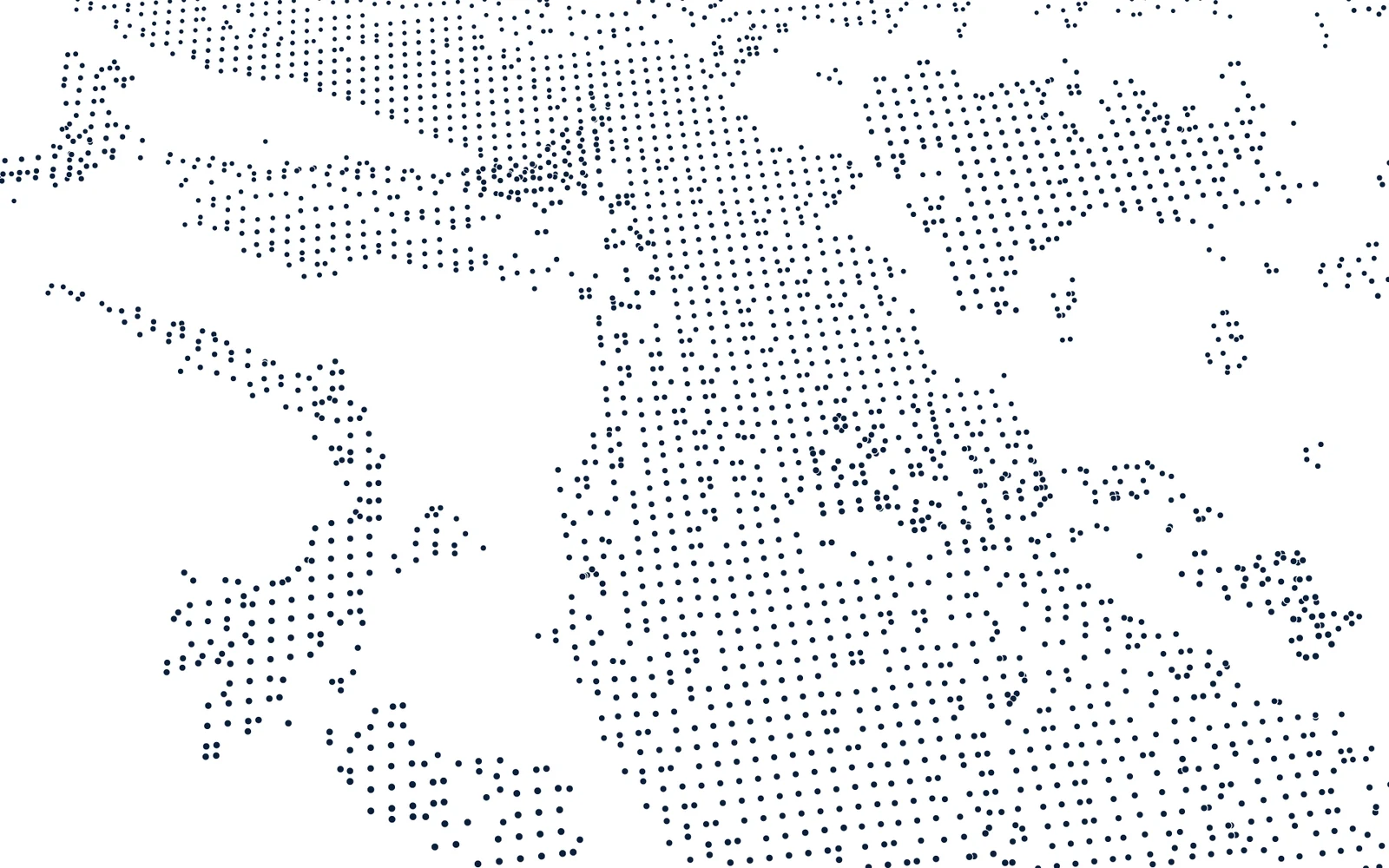
We lift the semantic masks into 3D using the per-pixel depth from the feed-forward reconstruction model and the recorded camera poses, which gives us a semantic point cloud of the whole sequence.
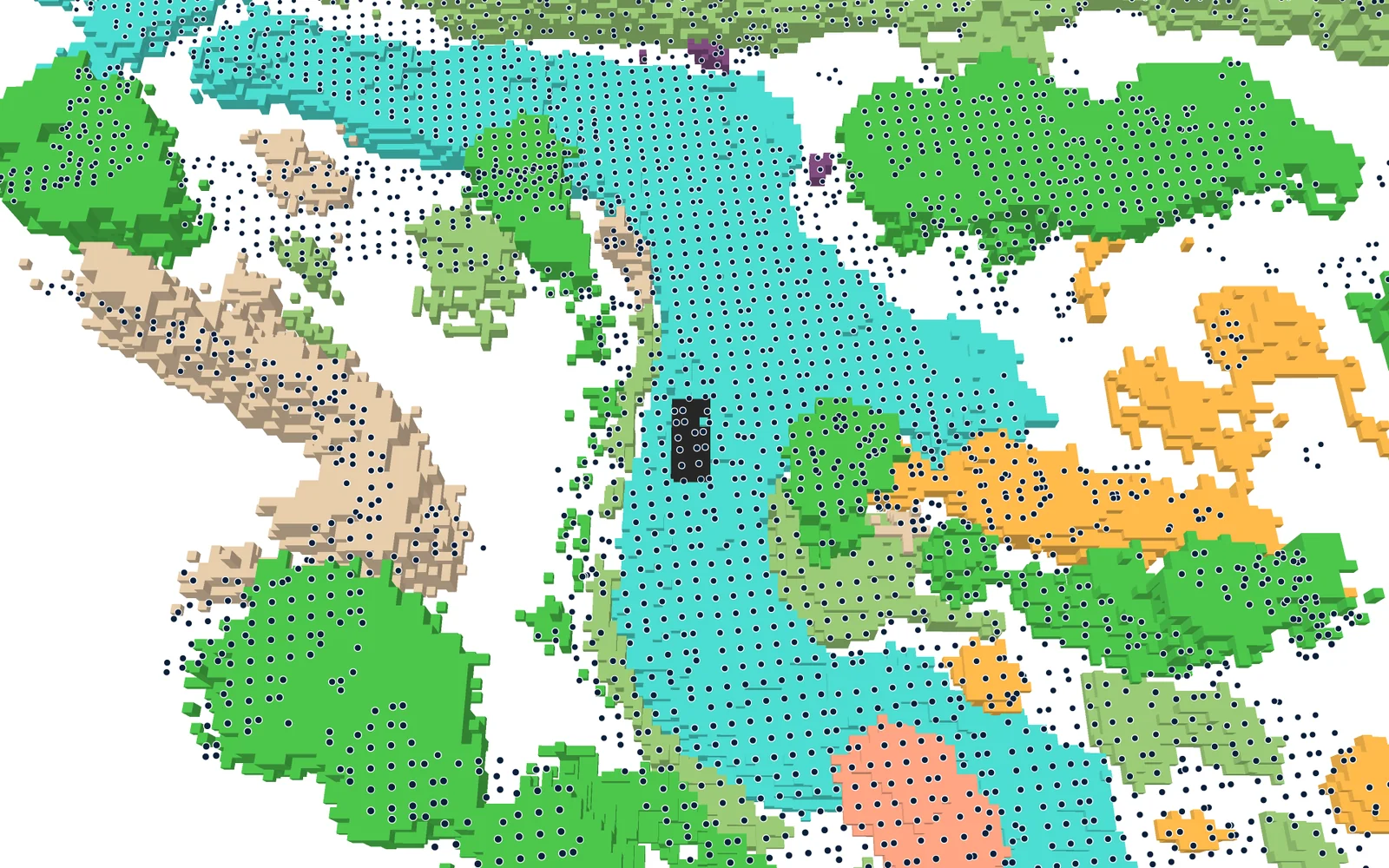
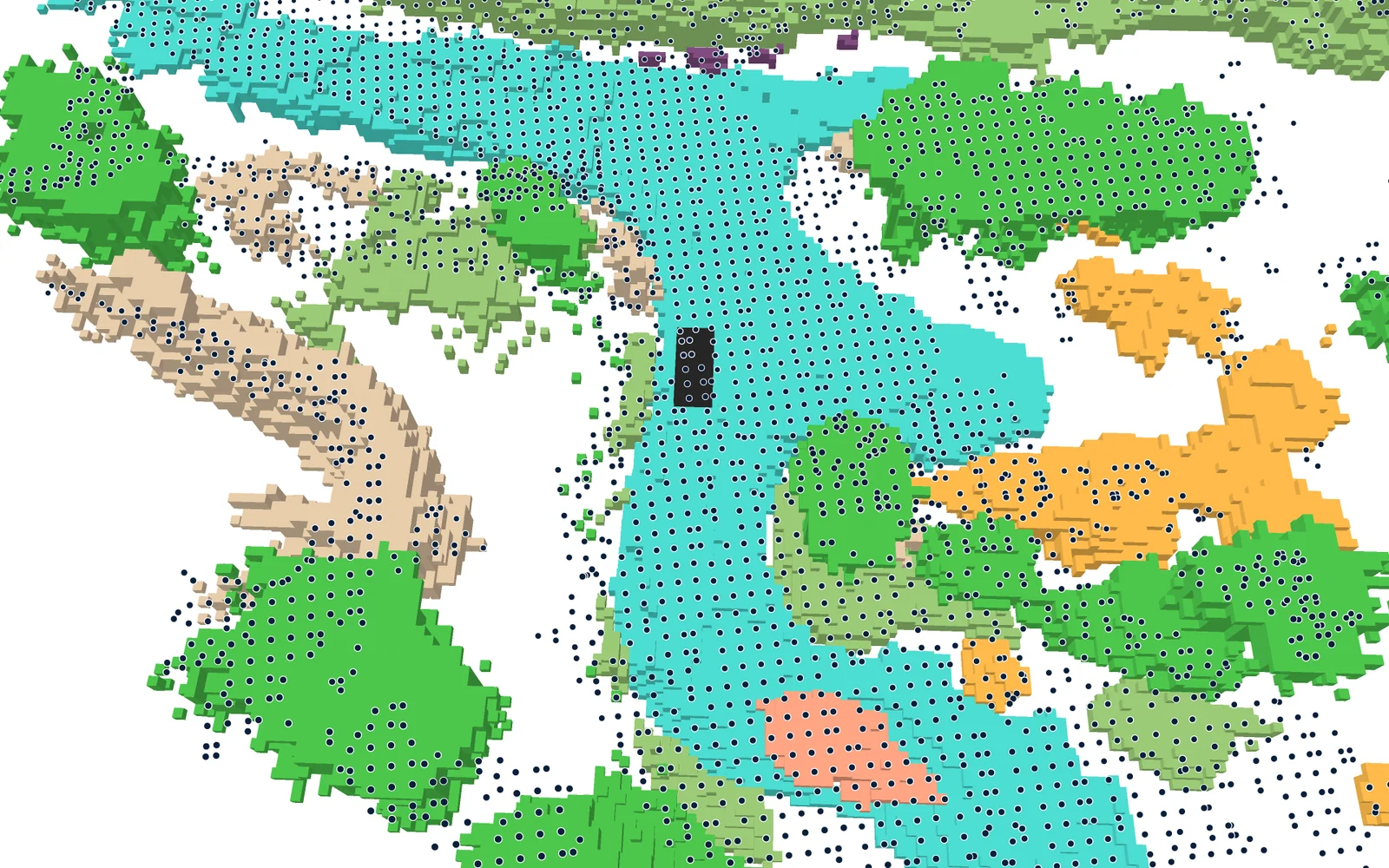
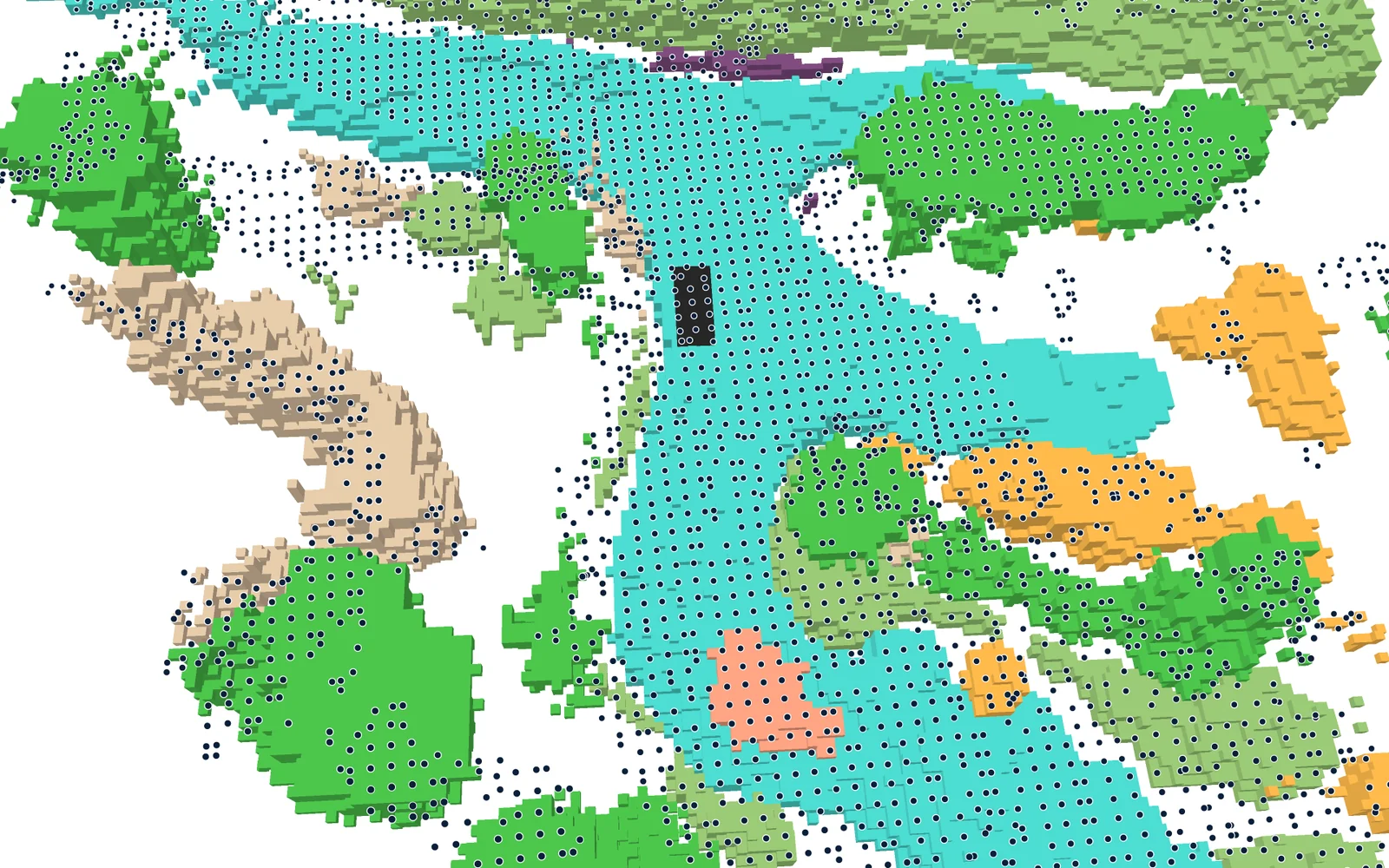
We classify instances as moving or static. Our method correctly identifies the bus following the ego vehicle and the pedestrians ahead as moving, and the parked cars as static, so we accumulate the parked cars into the static map.

 Observed only
With MOC
Drag to compare. Since the bus behind the ego vehicle is moving, we only observe its visible points (left). After we insert the points generated with SAM 3D Objects, its shape is much more complete (right).
Voxelization
We voxelize the combined point cloud, i.e., the accumulated static points and the completed moving objects, at two resolutions: a coarse grid with the Occ3D voxel size and a fine grid with twice the resolution. In addition, we store a dynamic mask that marks every voxel containing at least one point of a moving object. In Stage 2, we use the two grids for hybrid-resolution supervision and the dynamic mask for the motion-guided losses.
Click on a step to see an example from nuScenes.

 Coarse only (0.4 m)
Hybrid (objects at 0.2 m)
Drag to compare. On the left, we supervise one frame with the coarse grid only (0.4 m voxels). On the right, we use our hybrid resolution, where object classes come from the fine grid (0.2 m) and all other classes from the coarse grid. With the hybrid resolution, the cars keep much more of their shape.


We apply PseudoWorld to two sparse occupancy world models, SparseWorld and SparseWorld-TC. Both forecast future occupancy from past multi-view images, conditioned on the future ego trajectory.
Video
Qualitative Results

Quantitative Results
4D occupancy forecasting, Occ3D-nuScenes
Semantic mIoU and geometric IoU (%) at 1, 2 and 3 s. ‡ uses LiDAR depth supervision. * denotes the larger-input SparseWorld-TC-Small variant.
| Method | 2D GT | 3D GT | Semantic mIoU ↑ | Geometric IoU ↑ | FPS | ||||||
|---|---|---|---|---|---|---|---|---|---|---|---|
| 1s | 2s | 3s | Avg | 1s | 2s | 3s | Avg | ||||
| Fully supervised | |||||||||||
| OccWorld-D | ✗ | ✓ | 11.55 | 8.10 | 6.22 | 8.62 | 18.90 | 16.26 | 14.43 | 16.53 | 2.8 |
| PreWorld | ✓ | ✓ | 12.27 | 9.24 | 7.15 | 9.55 | 23.62 | 21.62 | 19.63 | 21.62 | – |
| SparseWorld | ✗ | ✓ | 14.93 | 13.15 | 11.51 | 13.20 | 22.96 | 22.10 | 21.05 | 22.03 | 8.0 |
| SparseWorld-TC-Small | ✗ | ✓ | 17.77 | 16.23 | 14.79 | 16.26 | 24.60 | 23.87 | 22.91 | 23.79 | 9.35 |
| 3D label-free | |||||||||||
| OccWorld-S | ✗ | ✗ | 0.28 | 0.26 | 0.24 | 0.26 | 5.05 | 5.01 | 4.95 | 5.00 | 2.8 |
| RenderWorld | ✓ | ✗‡ | 2.83 | 2.55 | 2.37 | 2.58 | 14.61 | 13.61 | 12.98 | 13.73 | – |
| PreWorld | ✓ | ✗‡ | 4.36 | 3.72 | 3.27 | 3.78 | 9.49 | 9.17 | 8.90 | 9.19 | – |
| Ours (+SparseWorld) | ✗ | ✗ | 6.66 | 5.94 | 5.30 | 5.97 | 15.00 | 14.64 | 14.26 | 14.63 | 8.0 |
| Ours (+SW-TC-Small) | ✗ | ✗ | 7.32 | 6.79 | 6.37 | 6.83 | 15.31 | 15.07 | 14.75 | 15.04 | 9.35 |
| Ours (+SW-TC-Small*) | ✗ | ✗ | 7.30 | 6.81 | 6.42 | 6.84 | 15.57 | 15.33 | 15.00 | 15.30 | 5.63 |
| Fully supervised | |||||||||||
| PreWorld | ✓ | ✓ | 18.71 | 14.55 | 11.67 | 14.98 | 40.15 | 37.66 | 35.50 | 37.77 | – |
| SparseWorld | ✗ | ✓ | 22.67 | 19.75 | 17.04 | 19.82 | 42.86 | 41.09 | 38.72 | 40.89 | 8.0 |
| SparseWorld-TC-Small | ✗ | ✓ | 27.95 | 25.51 | 23.35 | 25.60 | 50.69 | 49.15 | 47.23 | 49.02 | 9.35 |
| SparseWorld-TC-Small* | ✗ | ✓ | 30.09 | 27.61 | 25.43 | 27.71 | 52.66 | 51.20 | 49.31 | 51.05 | 5.63 |
| 3D label-free | |||||||||||
| Ours (+SparseWorld) | ✗ | ✗ | 13.49 | 12.09 | 10.73 | 12.10 | 39.10 | 37.78 | 36.03 | 37.64 | 8.0 |
| Ours (+SW-TC-Small) | ✗ | ✗ | 15.72 | 14.73 | 13.98 | 14.81 | 43.17 | 42.46 | 41.48 | 42.37 | 9.35 |
| Ours (+SW-TC-Small*) | ✗ | ✗ | 15.97 | 15.04 | 14.29 | 15.10 | 44.53 | 43.83 | 42.78 | 43.71 | 5.63 |
Bold marks the best 3D label-free result. Fully supervised methods (grey) are shown for reference.
3D occupancy prediction, Occ3D-nuScenes
Label-free methods. † uses STCOcc as the occupancy model.
| Method | RayIoU | @1 | @2 | @4 | mIoU |
|---|---|---|---|---|---|
| SelfOcc | 10.5 | 8.9 | 10.5 | 12.0 | 10.54 |
| GaussianOcc | 11.85 | 8.69 | 11.90 | 14.95 | 11.26 |
| TT-Occ-Camera | 13.4 | 10.0 | 12.9 | 15.7 | 16.70 |
| GaussianFlowOcc | 16.47 | 11.81 | 16.58 | 20.98 | 17.08 |
| ShelfOcc† | 19.97 | 14.38 | 20.07 | 25.47 | 22.87 |
| QueryOcc | 20.8 | – | – | – | 21.3 |
| LetOccVote-L | 20.91 | 15.80 | 21.30 | 25.62 | 23.11 |
| FreeOcc† | 21.1 | 13.6 | 21.3 | 28.5 | 22.8 |
| PseudoWorld (Ours)† | 23.75 | 18.52 | 24.38 | 28.36 | 24.86 |
4D occupancy forecasting, Occ3D-Waymo
SparseWorld-TC protocol. Semantic mIoU / geometric IoU (%), averaged over 1–3 s.
| Method | 2D GT | 3D GT | mIoU | IoU |
|---|---|---|---|---|
| Fully supervised | ||||
| PreWorld | ✓ | ✓ | 9.29 | 35.81 |
| SparseWorld-TC-S | ✗ | ✓ | 15.72 | 45.03 |
| 3D label-free | ||||
| PreWorld | ✓ | ✗ | 6.77 | 29.37 |
| Ours (+SW-TC-S) | ✗ | ✗ | 8.12 | 30.51 |
These are the first label- and LiDAR-free results for 4D semantic occupancy forecasting on Occ3D-Waymo.
Code, Pseudo-Labels & Models
We will publicly release the code, the generated pseudo-labels, and the trained models upon acceptance of the paper.
Publication
PseudoWorld: 3D Pseudo-Supervision for Semantic Occupancy World Models
arXiv preprint, 2026
If you find our work useful, please consider citing our paper:
@article{schischka2026pseudoworld,
  title={PseudoWorld: 3D Pseudo-Supervision for Semantic Occupancy World Models},
  author={Schischka, Nicolas and Mohan, Rohit and Valada, Abhinav},
  journal={arXiv preprint},
  year={2026}
}


Acknowledgement
This research has been conducted as part of the HIDDEN project, which is funded by the European Union, under grant agreement No 101202228. Views and opinions expressed are however those of the author(s) only and do not necessarily reflect those of the European Union or the European Climate, Infrastructure and Environment Executive Agency (CINEA). Neither the European Union nor the granting authority can be held responsible for them. Additionally, this work was funded by an academic grant from NVIDIA.